Tuesday, January 30, 2018

Wednesday, December 27, 2017
Oracle BPM Architecture

Oracle BPM Runtime
Oracle BPM Runtime or “service
infrastructure” provides the internal message transport infrastructure for
connecting components and enabling data flow. The service infrastructure is
responsible for routing messages along the wire connections between services,
service components, and references.
BPEL Service Engine
For process orchestration of
synchronous and asynchronous BPEL processes.
BPMN Service Engine
For creating and modeling
business processes using Business Process Management Notation and Modeling
(BPMN). The BPEL, BPMN and Process Core (provided shared services for both BPMN
and BPEL engines) are commonly called as BPM engine. According to Oracle documentation, BPMN Service Engine
is actually an extension of the existing BPEL Service Engine and as such it
leverages the core infrastructure of the BPEL. The BPMN Service Engine
leverages JPA/EclipseLink to store/recover the state of a process instance in the
SOA Infrastructure dehydration store maintained by a database and to persist
audit records that are created in the course of running a process. MDS APIs are
used to retrieve metadata Information about the BPMN Process Model and other
BPM project artifacts like the Business Catalog.
Business
Rules Engine
For making a
decision or for processing based on business rules.
Human
Workflow Engine
For modeling a
human task (for example, manual order approval) that describes the tasks for
users or groups to perform as part of an end-to-end business process flow.
This engine is
also used extensively in this tutorial. The details of its services are shown
below.
We can see
that the Human Task Workflow Engine are a major set of SOA components to manage
a wide range of human related services, including routing, roles and
permission, security, timers, interaction with user interface, and
notification.

User Interface and Data Control
Another
important aspect of BPM application is the interaction with users which is
implemented by Oracle ADF. Oracle ADF runs on top of Java Server Faces (JSF)
which abstracts HTML and Java Servlet technologies with web components.


The prominent contribution of Oracle ADF is the ADF Model layer which includes Data Control and Bindings as shown above. Other mechanism is primarily based on JSF infrastructure. The main idea of data control and data bindings is to simplify the process of binding UI elements with various data source in a declarative manner. Developers don’t need to bother with details of various data sources but only work with a common facilities provided by the Data Controls editor in Oracle JDeveloper. We will work with this facility during the human task implementation.
For BPM technology, Oracle provides a special data control called BPM data control which interacts with both BPMN and Human Workflow Engine. It hides the complexity in dealing with these two engines and ease the development efforts.
However, it is noted that Oracle ADF is a huge and complex technology stack on top of JSF, which requires a relatively steep learning curve.
For BPM technology, Oracle provides a special data control called BPM data control which interacts with both BPMN and Human Workflow Engine. It hides the complexity in dealing with these two engines and ease the development efforts.
However, it is noted that Oracle ADF is a huge and complex technology stack on top of JSF, which requires a relatively steep learning curve.
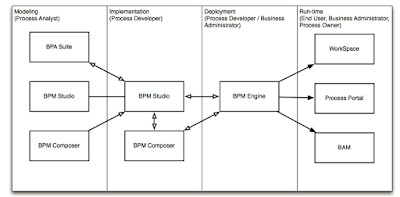
Development life cycle of an Oracle BPM
The stages of the development life cycle of an Oracle BPM application are outlined below

BPM - Basic Overview
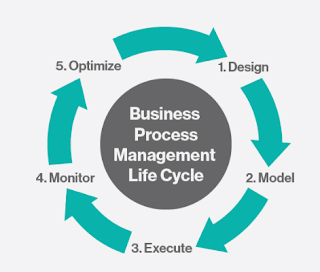
BPM stands for Business process management. BPM is a process centric approach for improving business performance that combines information technology with governance methodologies.BPM is a standardized way to convert a set of inputs to a desired and valuable output.


Pillars of BPM:
Benefits of BPM:


Pillars of BPM:
- Processes
- People
- Technology

Benefits of BPM:
- Increase Visibility
- Identify bottlenecks
- Optimization
- Reduction of Lead-times
- Definition of Roles
- Improves process efficiency
- Improves productivity
- Improves process control, supervisor can track and control
- Flexible process modeling
Sunday, April 7, 2013
Oracle SOA and Coherence: Seamless deployment and migration of BPEL processe...
Oracle SOA and Coherence: Seamless deployment and migration of BPEL processe...: One of the aspects that need to be taken care in developing the BPEL processes is the seamless migration of code from one environment to ano...
Tuesday, December 21, 2010
Q.What are the advantages of SOA?
Ans-SOA provides several significant benefits for the distributed enterprise system.Some of the most notable benefits includes:interoperability,efficiency and standardization
Interoperability:-
Interoperability is the ability of software on different systems to communicate by sharing data and functionality.SOA/Web Services are much more about web and
Internet scale computing.Most companies will have numerous business partners throughout life of the company.Instead of writing a new addition to your application everytime you gain a new partner, you can write one interface using web Service technology like SOAP.So now your partner can dynamically find the services using UDDI and bind to them using SOAP.You can also extend interoperabilty of your system by implementing the webservices within your intranet.With the addition of Web Services to your intranet system and to your extranet, you can reduce the cost integration , increase communication and increase your customer base.
Efficiency:-SOA enable you to reuse your existing applications.Instead of creating totally new applications, you can create them using various combinations of service exposed by your existing applications.Developers can be more efficient because they can focus on learning industry standard technology.They willnot have to spend a lot of time learning every new technologies that arises.For a manager this means this means a reduction in the cost of buying new software and having to hire new developers with new skill sets.This approch will allow developers to meet changing business requirements and reduce the length of development cycles for projects.Overall, SOA provides for an increase in efficiency by allowing applications to be reused,decreasing the learning curve of developers, speeding up the total development process.
Standardization:-For something to be true starndard, it must be accepted and used by majority of the industry.One vendor or small group of vendors must not controll the evolution of technology or specification.Most if not all the industry leaders are involved in the development of Web Service Specifications.Almost all businesses now-a-days use the internet or world wide web in one form or another.The underlying protocol for WWW is ofcourse HTTP.The foundation of Web Services is built upon HTTP and XML.Although does not mandate a particular implementation framework , iteroperabilty is important and SOAP is one of the few protocol that all good SOA implementations can agree on.
Interoperability:-
Interoperability is the ability of software on different systems to communicate by sharing data and functionality.SOA/Web Services are much more about web and
Internet scale computing.Most companies will have numerous business partners throughout life of the company.Instead of writing a new addition to your application everytime you gain a new partner, you can write one interface using web Service technology like SOAP.So now your partner can dynamically find the services using UDDI and bind to them using SOAP.You can also extend interoperabilty of your system by implementing the webservices within your intranet.With the addition of Web Services to your intranet system and to your extranet, you can reduce the cost integration , increase communication and increase your customer base.
Efficiency:-SOA enable you to reuse your existing applications.Instead of creating totally new applications, you can create them using various combinations of service exposed by your existing applications.Developers can be more efficient because they can focus on learning industry standard technology.They willnot have to spend a lot of time learning every new technologies that arises.For a manager this means this means a reduction in the cost of buying new software and having to hire new developers with new skill sets.This approch will allow developers to meet changing business requirements and reduce the length of development cycles for projects.Overall, SOA provides for an increase in efficiency by allowing applications to be reused,decreasing the learning curve of developers, speeding up the total development process.
Standardization:-For something to be true starndard, it must be accepted and used by majority of the industry.One vendor or small group of vendors must not controll the evolution of technology or specification.Most if not all the industry leaders are involved in the development of Web Service Specifications.Almost all businesses now-a-days use the internet or world wide web in one form or another.The underlying protocol for WWW is ofcourse HTTP.The foundation of Web Services is built upon HTTP and XML.Although does not mandate a particular implementation framework , iteroperabilty is important and SOAP is one of the few protocol that all good SOA implementations can agree on.
Q.What is basics of SOA?Or What are the three roles of SOA?
Traditional distributed computing environments have been tightly coupled in that they don't want a changing environment as well.For instance if an application is interacting with another application how do they handle the data types or data encoding if data types in one system changes? How are incompatible data types handled?
The service Oriented Architechture consists of three roles : requestor, provider and broker.
Service Provider:-A service provider allows the access to the services, create a description of a service and publish it to the service broker.
Service Requestor:-A service requestor is responsible for discovering a service by searching through the service description given by the service broker.A service requestor is also responsible for binding to services provided by the service provider.
Service Broker:-A service broker hosts a registry of service descriptions.It is responsible for linking a requestor to the service provider.
The service Oriented Architechture consists of three roles : requestor, provider and broker.
Service Provider:-A service provider allows the access to the services, create a description of a service and publish it to the service broker.
Service Requestor:-A service requestor is responsible for discovering a service by searching through the service description given by the service broker.A service requestor is also responsible for binding to services provided by the service provider.
Service Broker:-A service broker hosts a registry of service descriptions.It is responsible for linking a requestor to the service provider.
Subscribe to:
Posts (Atom)